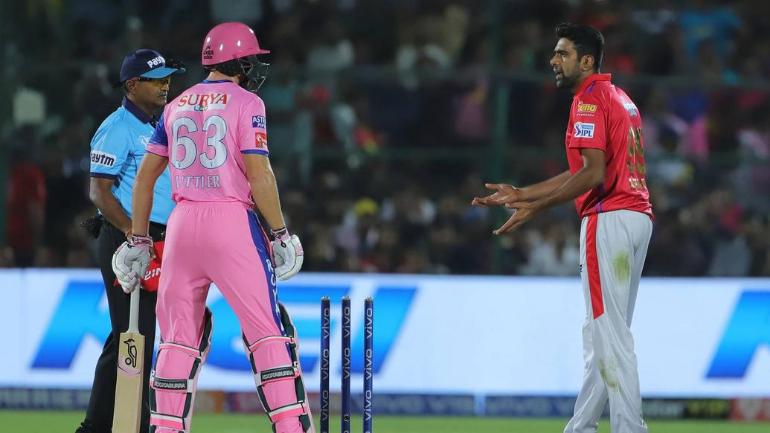
The tides of well known sentiment are typically fairly moderate to move, however it appears Ravichandran Ashwin has done what old King Canute proved unable. By pulling up in his keep running up and viewing the ever-dozy Jos Buttler float unyieldingly out of his wrinkle before whipping of the safeguards, Ashwin put forth an open defense for the baldfaced, cautioning free, unashamed Mankad, and it appears to reverberate with the gathering of people, at any rate if that group of onlookers is twitter. Ashwin has started the recovery of Vinoo Mankad, and beyond any doubt, it’s likely past due.
So Mankads are cool at this point.
The MCC have been pushing a similar line for quite a while, changes to the Laws in 2017 and again only a couple of days back both making it less demanding to run out the non-striker before conveying the ball and trying to move the fault conclusively onto the batsman. I’ll concede at the time I gived a shout out to them, alongside Keemo Paul as he pushed the limits of what should be possible to careless or oblivious batsmen.
Be that as it may, as an early-adopter of the “Mankads are fine, Mankads are fun” guideline, the abrupt fame of my once restless and non-conventionalist sees has definitely abandoned me irritated and fractious, and searching for some better approach actually, I get myself unfit to make the most of Ashwin’s mankadding perfect work of art. Or on the other hand possibly it’s simply the way that Buttler wasn’t in reality out. The new Laws and the official statements that went with the progressions have been genuinely unequivocal in their enemy of bat position, presently giving the bowler until the purpose of expected conveyance instead of simply the conveyance walk to choose to run out the non-striker while expressly putting the onus on the hitter to remain in his or her wrinkle – they don’t give the bowler all the time he needs, rather the Law keeps running as pursues: 41.16 Non-striker leaving his/her ground early. It says: If the non-striker is out of his/her ground from the minute the ball becomes an integral factor to the moment when the bowler would typically have been relied upon to discharge the ball, the bowler is allowed to endeavor to run him/her out. Regardless of whether the endeavor is fruitful or not, the ball will not include as one in the over. Presently beside the undeniable reality this is an inadequately worded Law and everything except unenforceable in the 99% of cricket recreations that don’t have the advantage of a TV umpire, it additionally implies Buttler ought not have been given out. At the point when Ashwin prematurely ended his activity Buttler’s bat was as yet grounded well inside the wrinkle. Ashwin then viewed Buttler dozily stray down the track, and possibly took the safeguards off when poor old Jos, seeing that the ball hadn’t showed up behind him obviously, at long last pivoted to check out his (presently probably commonplace) circumstance. This is in fact very engaging, yet it is neither in the “soul” nor, rather more vitally the letter of the Law.
That letter, being a seriously built, can be translated in no less than two diverse ways, yet by nor is Buttler unmistakably out. Either Ashwin expected to finish the run-out before the point where he would somehow or another have conveyed the ball, in which case he was excessively late, or it is adequate for Buttler to have been out of his ground at the “purpose of anticipated conveyance” which he (likely) wasn’t. Without a split-screen correlation between the run-out and a finished conveyance, it’s hard to be totally sure on the last point, yet then the TV umpire did not give off an impression of being notwithstanding thinking about it. The consequent choice was, by the present Laws, just the wrong one. Buttler along these lines has each option to feel oppressed, however he should presumably coordinate his hatred toward the umpires, not his rivals. Ashwin was altogether qualified for endeavor the run-out, however it ought not have been given for this situation. However even had the right choice been made, Buttler precluded not and a dead ball called, one presume a critical part of the cricketing network would at present be baffled, the Mankad fans on twitter, yet in addition the more traditionalist commentariat that still holds notwithstanding endeavoring to run out the non-striker as commensurate to swindling.
It is an infuriating however certain reality for Mankad fans that the method of expulsion’s team promoters are practically all to be found among columnists, bloggers, and other web clients – while conclusion among present and previous players is generally threatening (at any rate among batsmen, who for reasons unknown appear to be the most vocal on the inquiry.)
Sooner or later, it’s insufficient just to point at the Laws and tell these moderates that they’re basically wrong or don’t have the foggiest idea about the principles. Changes to the Laws of cricket, generally, ought to pursue the amusement as it is played, not look to transform it unduly. The Mankad obviously doesn’t sit well with most of players, and the Law as it is right now composed is essentially futile at recreational dimension in any case. The way that there is still some desire that a notice be given both reflects and fortifies the discernment that the Mankad is, if not tricking, somewhere around a to some degree insidious type of rejection, yet the ongoing changes to the Laws and the going with preface are fairly off key with this supposition – recommending the careful inverse.
Indeed, even in setting the new Law under segment 41 (unjustifiable play) as opposed to under 38 (run outs) the suggestion in the Laws, strengthened by the MCC’s own announcements, is that it in actuality the batsman who, if not exactly swindling, is at any rate taking part in sharp practice. The inconvenience is that support up has for quite some time been a piece of the diversion and is all around drilled at all dimensions. Trying to dispose of it by fiat is probably going to demonstrate counter-beneficial, by the saying that condemning the typical simply undermines the Law.
In this regard, it’s truly clear the MCC is totally inconsistent with the remainder of the cricket world. One can absolutely blame Buttler for lethargy and heedlessness, particularly given this isn’t the first run through he’s been out support up and Ashwin has both a reputation and a freely expressed position on the training. Similarly one can appropriately call attention to that over the top sponsorship up presents favorable position, and each crawled picked up toward one side may be the inch at the other that keeps a run-out, yet the possibility that leaving the wrinkle early is out and out swindling simply doesn’t sit well either.
The identical that is regularly utilized by Mankad-lovers – that of picking off a base-sprinter initiating or hoping to take a base – is really informative here. Endeavoring to take a base in baseball isn’t respected deceiving, just hazard taking inside the structure of the principles. In like manner the pitcher endeavoring the pick-off isn’t viewed as tricking, yet then obviously there’s dependably the danger of a wild toss yielding a base.
What’s more, there’s the essence. On the off chance that or when the Mankad progresses toward becoming standardized, there can be no doubt of sponsorship up being conning, as it is just searching for preferred standpoint at the cost of a going with hazard, the same as the striker descending the track with the guardian up. Yet, there is no opposite hazard for the bowler endeavoring a Mankad. The bowler could in principle endeavor a Mankad on each ball and the main outcome would be a string of dead ball calls.
This absence of danger for the bowler is, one suspects, at any rate some portion of the reason Mankads remain so disagreeable among players. The hazard is all on the batsman and not on the bowler, consequently the inclination that the expulsion is “fearful,” an estimation definitely emerging from this fundamental absence of aggressive parity. There is, luckily, a genuinely direct fix to this issue, one which only includes expelling a trivial proviso to another as of late presented principle, specifically Law 21.6 – AKA the “Finn Rule”.
21.6 Bowler breaking wicket in conveying ball: Either umpire will call and flag No ball if, other than trying to run out the non-striker under Law 41.16 (Non-striker leaving his/her ground early), the bowler breaks the wicket whenever after the ball becomes possibly the most important factor and before fulfillment of the walk after the conveyance walk. This will incorporate any dress or other article that tumbles from his/her individual and breaks the wicket.
Scrap the exclusion for fizzled Mankads, and all of a sudden an endeavor to run out a non-striker is never again chance free, supposing that the batsman’s sheltered it costs the bowler a no ball and a free hit. Like a timid at the stumps from separation with no one sponsorship up, the Mankad is never again a free-wicket choice. Chaos it up and you’ll go for runs.
The purpose of the progressions to the principles around the Mankad was to change view of the rejection, and in that regard it appears as if Ashwin may simply have succeeded where the MCC flopped, at any rate among the commentating classes. Be that as it may, looking to demonize the hitter for support up can’t be the appropriate response either. The Laws should work essentially to encourage rivalry and amusement, not to blame normal practices. With a couple of minor alterations and the whole inquiry of non-striker run-outs and sponsorship up could be made piece of the focused texture of the amusement instead of remain a wellspring of on-field bitterness and round contentions on twitter.
In this perfect world, one would take a gander at a careful redundancy of the Buttler rejection and see no poor sportsmanship on any side, just poor play. Apathetic support up from Buttler, a tarrying endeavored Mankad from Ashwin, and a dodgy choice to boot. Poor cricket all round. Play on.
 Sports News: Cricket News, Latest updates on Tennis, Football